Jona Lendering
Jona Lendering read history at Leiden University (MA 1993), specialized in Mediterranean culture at the Amsterdam Free University (MA 1996), and worked at excavations in Holland (Riethoven) and Greece (Halos). After teaching historical theory and ancient history at the Free University for several years, he was one of the founders of a school for history teaching, Livius Onderwijs. Born in Amsterdam, it has now spread to auxiliary locations in Bussum, Dronten, Gouda, Haarlem, Hoorn, Schagen, Zaanstad, and Zoetermeer. As of 2013, Livius Onderwijs has eight teachers, about 500-600 students a year, and offers tours to countries like Italy, Turkey, Iran, and Lebanon. The field trips help to etch into the students' minds some of what they've learned at the school.
Because history is for a large part telling a story, something you do best in your own language, Lendering prefers to publish in Dutch journals. However, he has contributed to the Bryn Mawr Classical Review and Ancient Warfare, while he is the founder of Ancient History Magazine. He is also the publisher and editor of the on-line publication of the Babylonian Chronicles of the Hellenistic Period, a set of important cuneiform sources for the history of the Seleucid and Parthian Near East, transcribed, translated and commented on by Bert van der Spek of the Free University Amsterdam and Irving Finkel of the British Museum. A publication as book is in preparation.
Lendering has written several books and maintains a blog in Dutch. He is the author of several books, including Edge of Empire and Consensus and Crises. For the Livius website, which has received several awards, he collaborates closely with Bill Thayer of LacusCurtius. Lendering is also the webmaster of two daily blogs, the MainzerBeobachter.com and Grondslagen.net.
There are 9380 items in Jona Lendering:
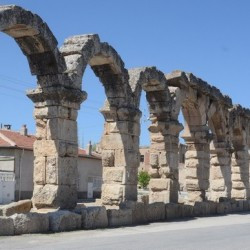
Tyana, Aqueduct |
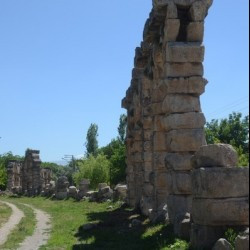
Tyana, Aqueduct |
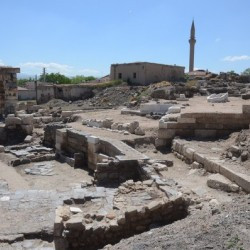
Tyana, City center (nymphaeum?) |
Tyche of Antioch
The Tyche of Antioch: statue of the goddess of fortune, created by Eutychides of Sicyon. It is the best-known piece of Seleucid art. …Typhon
Typhon (Greek Τυφῶν): in Greek mythology a giant monster, opponent of the supreme god Zeus and the Olympian gods. Typhon The first…Tyrant
Tyrant: sole ruler in a Greek city-state, usually an usurper, who held power in defiance of a city's constitution. Originally, the word did not have any negative connotations. …Tyre
Tyre (Phoenician צר, ṣūr, "rock"; Greek Τύρος; Latin Tyrus): port in Phoenicia and one of the main cities in the eastern Mediterranean.Origins …Tyre - photos
Tyre (Phoenician צר, ṣūr, "rock"; Greek Τύρος; Latin Tyrus): port in Phoenicia and one of the main cities in the eastern Mediterranean.Photos …Tyre - texts
Tyre (Phoenician צר, ṣūr, "rock"; Greek Τύρος; Latin Tyrus): port in Phoenicia and one of the main cities in the eastern Mediterranean.Texts Herodotus: the Temple of Melqart Menander of Ephesus: Hiram and Salomo Aššurbanasirpal II: the Expedition to the Lebanon (ANET3 276) Menander of…Tyre (2)
Tyre (Phoenician צר, ṣūr, "rock"; Greek Τύρος; Latin Tyrus): port in Phoenicia and one of the main cities in the eastern Mediterranean.Babylonia and Persia …Tyre (3)
Tyre (Phoenician צר, ṣūr, "rock"; Greek Τύρος; Latin Tyrus): port in Phoenicia and one of the main cities in the eastern Mediterranean.The Hellenistic Age …Tyre, Al-Bass Cemetery
Tyre (Phoenician צר, ṣūr, "rock"; Greek Τύρος; Latin Tyrus): port in Phoenicia and one of the main cities in the eastern Mediterranean.Cemetery …